Expert Kidney Stone Treatment in Pitampura: Say Goodbye to Pain at Laser Stone Hospital
Have you ever woken up in the middle of the night with a sharp, stabbing pain in your side that just won’t let you catch your breath? If you have, you know exactly how terrifying and exhausting kidney stone pain can be. It is often described as one of the most intense physical experiences a person can go through. But here is the good news: you don’t have to endure it. If you are looking for kidney stone treatment in Pitampura, you are already in the right place to find a permanent solution.
Think of your urinary system as a smooth, flowing river. Sometimes, due to various reasons, little “boulders” start to form in the riverbed. These boulders—kidney stones—don’t just sit there; they can block the flow, causing the “water” to back up and create immense pressure. You wouldn’t try to clear a blocked river with a spoon, would you? You’d want an urologist in Pitampura who knows exactly how to break down those barriers and restore the natural flow.
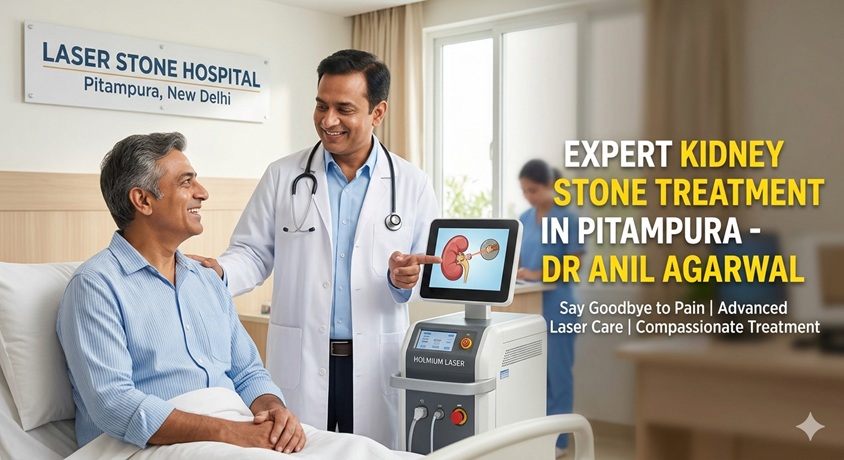
At Laser Stone Hospital, led by the highly experienced Dr. Anil Agarwal, we specialize in turning that “blocked river” back into a peaceful stream. We combine advanced laser technology with a gentle, human touch to ensure that your journey from pain to relief is as quick as possible. Whether you’ve just felt that first twinge of discomfort or you’ve been struggling with recurring stones for years, this guide is designed to help you understand your options and feel confident about your care.
1. What Exactly Are Kidney Stones?
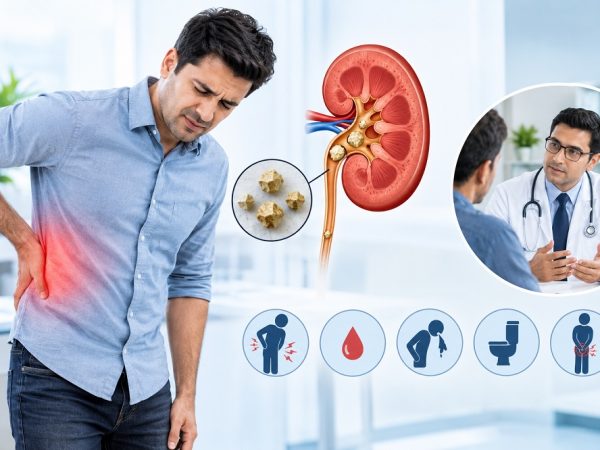
Kidney stones are essentially hard collections of salt and minerals that bunch together inside your kidneys. They can be as tiny as a speck of dust or, in rare cases, as large as a ping-pong ball. While they start in the kidney, the real pain happens when they try to travel through the ureter—the narrow tube connecting the kidney to the bladder.
Because the ureter is so thin, even a small stone can act like a cork in a bottle. This blockage is what causes that signature “colic” pain. Understanding that these are physical objects helps you realize why “waiting it out” isn’t always the best strategy. Professional kidney stone treatment in Pitampura focuses on either helping these stones pass safely or breaking them down into manageable pieces.
2. Common Symptoms: How to Tell It’s a Kidney Stone
Is it just a backache, or is it something more? Many people mistake early kidney stone symptoms for muscle strain. However, kidney stone pain has a very specific personality:
-
The “Waves” of Pain: The discomfort often comes in intense waves that last for 20 to 60 minutes.
-
Location: Usually starts in the back or side, just below the ribs, and may move toward the lower abdomen or groin.
-
Urinary Changes: You might notice pink, red, or brown urine, or a frequent, urgent need to go.
-
Nausea: It is very common to feel sick to your stomach or vomit because the pain is so severe.
If you are experiencing these, don’t ignore them! Early consultation at Laser Stone Hospital can prevent a minor issue from becoming an emergency.
3. Why Do Stones Form? The Science Made Simple
Our bodies are incredible chemists. Normally, our urine contains substances that prevent crystals from sticking together. But sometimes, the balance gets tipped.
Common culprits include:
-
Dehydration: If you don’t drink enough water, your urine becomes concentrated with minerals.
-
Diet: Too much salt, sugar, or certain proteins can increase stone risk.
-
Family History: If your parents had stones, your “chemistry” might be more prone to creating them.
-
Medical Conditions: Issues like gout or certain urinary tract infections can trigger stone growth.
4. Meet Dr. Anil Agarwal: Your Trusted Specialist
When you are in pain, you want a doctor who is not only a master of technology but also a master of empathy. Dr. Anil Agarwal is widely regarded as an expert in kidney stone treatment in Pitampura. With decades of experience and a track record of thousands of successful laser procedures, he has built a reputation for being thorough and approachable.
Dr. Agarwal doesn’t believe in “one size fits all” medicine. He takes the time to sit with you, look at your scans, and explain exactly why a certain treatment—whether it’s lifestyle changes or laser surgery—is the right path for your specific body.
5. Why Laser Stone Hospital is the Best Choice in Pitampura
Why do people travel from all over North-West Delhi to see us? It’s because Laser Stone Hospital was built with one goal: to provide world-class stone care in a local, friendly setting.
-
Specialized Focus: Unlike general hospitals, we live and breathe stone care.
-
Advanced Technology: We use the latest Holmium Laser systems that allow for bloodless, incision-free surgeries.
-
Comfort: Our facility is designed to be calming, reducing the “hospital anxiety” many patients feel.
6. Modern Diagnostics: Seeing the Problem Clearly
Before we can treat a stone, we have to find it. We use high-definition imaging to create a “map” of your urinary tract.
-
Digital X-Rays: To quickly spot most types of stones.
-
Ultrasound: A safe, radiation-free way to see the kidneys and bladder.
-
NCCT (Non-Contrast CT Scan): This is the “gold standard.” it tells us the exact size, location, and even the hardness of the stone.
By knowing the “hardness” of the stone, Dr. Agarwal can decide exactly how much laser energy is needed to turn it into dust.
7. Non-Surgical Options for Small Stones
Not every stone requires a trip to the operating room! If your stone is small (usually less than 5mm or 6mm), we might suggest Medical Expulsive Therapy (MET).
This involves:
-
Hydration Therapy: Flushing the system with plenty of fluids.
-
Specialized Medications: To relax the muscles of the ureter, making it easier for the stone to slip through.
-
Pain Management: To keep you comfortable while your body does the work.
8. Advanced Laser Treatments: RIRS and Beyond
For stones that are too big to pass, we use RIRS (Retrograde Intrarenal Surgery). This sounds complex, but it’s actually incredibly patient-friendly.
The Process: Dr. Agarwal uses a very thin, flexible tube with a camera (an endoscope) that goes through the natural urinary passage. There are no cuts or incisions on your body. Once the stone is located, a laser fiber “fires” at the stone, breaking it into tiny fragments or “dust” that you simply pee out later. It’s like magic—the stone is gone, and you don’t even have a stitch!
9. PCNL: Solving the Problem for Larger Stones
Sometimes, a “boulder” is just too big for the RIRS method. In these cases, we use PCNL (Percutaneous Nephrolithotomy).
The Modern Way: In the past, this meant a big scar. Today, at Laser Stone Hospital, we perform “Mini-PCNL.” We make a tiny, pencil-sized entry in the back to reach the kidney directly. This allows Dr. Agarwal to remove large or “staghorn” stones effectively while ensuring you recover much faster than traditional open surgery.
10. The “Laser” Advantage: Why It’s the Future of Care
Why is laser the preferred method for kidney stone treatment in Pitampura?
-
Precision: The laser only targets the stone, leaving the surrounding kidney tissue perfectly healthy.
-
Speed: Most procedures take less than an hour.
-
Recovery: Most patients go home within 24 hours and are back to their normal routine in a couple of days.
-
Safety: It’s effective even for stones that are very hard or located in tricky corners of the kidney.
11. Life After Treatment: How to Stay Stone-Free
Removing the stone is only half the battle. We don’t want to see you back in our emergency room a year from now! At Laser Stone Hospital, we provide a personalized “Stone Prevention Plan.”
This often includes:
-
Stone Analysis: We test the stone we removed to see what it was made of.
-
Metabolic Testing: A blood and urine check to see if your body is “leaking” too much calcium or uric acid.
-
Dietary Advice: Specific tips on what foods to embrace and which ones to moderate.
12. The Importance of Drinking Water (The Right Way!)
Everyone says “drink more water,” but how much is enough? For stone-formers, the goal is to produce about 2 to 2.5 liters of urine a day.
Pro-Tip: Add a squeeze of fresh lemon to your water. Lemons are rich in citrate, a natural “stone-fighter” that prevents crystals from sticking together. Think of it as adding a natural non-stick coating to your kidneys!
13. Patient Success: Real Stories from Pitampura Residents
We’ve helped thousands of your neighbors return to a pain-free life. From the grandfather who can now play with his grandkids without back pain to the young professional who was terrified of surgery but found the laser procedure “surprisingly easy,” our patients are our best advocates. Their stories remind us every day why we do what we do.
14. Conclusion
Kidney stones are a heavy burden to carry, both physically and mentally. But you don’t have to carry them alone. With the expertise of Dr. Anil Agarwal and the specialized technology at Laser Stone Hospital, effective and gentle kidney stone treatment in Pitampura is more accessible than ever before. You deserve to live a life free from the fear of the next “attack.” Whether you need immediate relief or long-term prevention, we are here to help you every step of the way. Let’s get that “river” flowing smoothly again!
Frequently Asked Questions (FAQs)
1. Is kidney stone laser surgery safe for elderly patients?
Yes! Because laser procedures like RIRS are minimally invasive and involve no large incisions, they are generally much safer and easier to recover from for seniors compared to traditional surgery.
2. How long will I need to stay in the hospital after laser treatment?
Most of our patients are discharged within 24 hours. Many even return home the same evening, depending on the complexity of the stone.
3. Does the procedure hurt?
The surgery is performed under anesthesia, so you will feel absolutely nothing during the procedure. Afterward, you might feel a mild “heaviness” or a frequent urge to urinate for a day or two, but it is nothing compared to the stone pain itself.
4. Can kidney stones come back after laser treatment?
The laser removes the existing stones, but it doesn’t change your body’s chemistry. That is why we emphasize our “Stone Prevention Plan” to help you change your diet and habits to stop new stones from forming.
5. How much water should I drink to prevent stones?
A good rule of thumb is to drink enough so that your urine is always clear or very pale yellow. If it’s dark yellow, your body is telling you it needs more water!